

Gas Grill Repair & Maintenance
Propane/Natural Gas Conversion
Fundamentals
Gas grills, like any other appliance, are designed and engineered to definite specifications with specific components. There is no single and easy way to safely or properly convert your grill by simply drilling the orifice or changing the supply line. All components have to be considered to maintain the integrity and safety of the system.Certification and Design
Gas Grills are designed and certified to operate on a single type of gas supply. The type of gas will be shown on the nameplate data. Although some premium brand manufacturers offer conversion kits, in the majority of cases if you change the supply type or convert your grill from one type to another you will void all warranties and certifications. Check with your local dealer or the manufacturer.Propane or L/P Gas Supply
Grills operating on propane operate at a higher gas pressure than those on natural gas. The operating pressure is determined by the regulator. On those homes using propane as a gas source, a grill set up for propane can generally be supplied directly from a house line as the pressure is regulated at the tank. Check with your propane dealer to assure compatibility.Natural Gas or N/G Gas Supply
Although the natural gas pressure supplied to your home is regulated by your local gas company, some grills designed for natural gas also incorporate an additional regulator at the grill to assure the maximum gas pressure supplied to the grill. The majority of newer natural gas models do not use an additional regulator and connect directly to the home natural gas supply line.BTU Ratings
Grill models are individually designed to operate at specific BTU ratings. The BTU rating is a measurement of how much heat your grill will generate and this rating can be found on the nameplate data on your grill.Typical Grill Nameplate
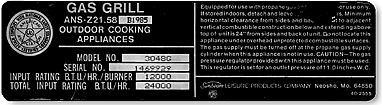 The nameplate data may state the BTU rating in two different ways - as per burner or as a total rating for the grill. As an example the rating may be 40,000 BTUs total or 20,000 BTU's per burner. (This becomes particularly confusing when you model incorporates a "dual" burner which is manufactured as a single unit with each side individually controlled by it's own control knob. In this case each side would have a 20,000 BTU rating for a total of 40,000 BTUs.) Typical grills don't exceed 40,000 BTUs, but there are many high-heat exceptions.
Orifice Size
The valve orifice fitting is the fitting at the end of the valve which has a small hole drilled into it's center. Most orifice fittings will have their size stamped either on the top or side of the fitting. The orifice size is the actual hole diameter in the orifice fitting. Drill bits although most commonly sold by inch increment size are also available by number. Thus a #56 size orifice is an orifice fitting that has been drilled with a #56 drill bit. Drill bit numbers and sizes have an inverse relationship. The larger the number, the smaller the drill bit. (Orifice hole size will be larger for natural gas supply models than propane because of the lower natural gas operating pressure). The actual BTU output is determined by the pressure of the gas supplied, volume of gas which is regulated by the valve and by the orifice fitting orifice hole size. As an example, assuming a fixed natural gas pressure of 3.5 inches of water column a #48 orifice will give a different BTU output than a #46. (Altitude also affects the BTU rating.)Click Here to See Our BTU and Orifice Size Guide
| BTU and Orifice Size Guide | ||||||
BTU Input |
Natural Gas Pressure |
L/P Gas Pressure |
||||
| 3.0" | 3.5" | 4.0" | 4.5" | 7.0" | 11" | |
| 10,000 | 51 | 52 | 1/16 | 53 | 54 | 62 |
| 12,000 | 50 | 50 | 51 | 51 | 53 | 59 |
| 14,000 | 48 | 49 | 50 | 50 | 52 | 57 |
| 16,000 | 46 | 5/64 | 48 | 49 | 51 | 56 |
| 18,000 | 45 | 46 | 47 | 48 | 50 | 55 |
| 20,000 | 44 | 44 | 45 | 46 | 49 | 54 |
| 25,000 | 3\32 | 42 | 43 | 44 | 46 | 53 |
| 30,000 | 38 | 40 | 41 | 42 | 44 | 52 |
| 35,000 | 35 | 36 | 38 | 39 | 42 | 50 |
| 40,000 | 31 | 33 | 35 | 36 | 41 | 48 |
| Drill Sizes | ||||||
| K Factor .82 | Calculation Based on: Natural-1050 BTU Gas -0.65 Spec. Gr. L/P-2500 BTU Gas - 1.55 Spec Gr. Approximate sizes based on average data for all orifice types. |
|||||
Control Valves
Control valves regulate the volume of gas supplied to the burner. Valves have specific maximum BTU ratings and are ported internally to specific sizes. This means that if you are attempting to convert from propane to natural gas, the volume of gas supplied to the burner may not produce a sufficient amount of heat at a HIGH setting even with a correct orifice size. Additionally and more importantly, at the LOW setting the volume of gas may be so low as to allow the burner to go out with a small amount of gas still flowing causing the risk of explosion.In limited cases the control valve may be adjustable by an adjustment screw accessible through the end of the valve stem which adjusts the valve characteristics. With this type of valve the internal porting can be increased or decreased as appropriate.
The Meat of it All
If you are interested in converting your grill, the best place to start is to contact your manufacturer or the dealer where you purchased your grill to assure compatibility.Find replacement parts for your gas grill now!
Find Grill Parts Now








Please note: The information provided is not intended to take the place of the owners manual that was supplied with your grill. Specific safety, repair and maintenance information varies between grill models and brands. Always refer to your owners manual.